
Rhinoplasty
Surgical Archetypes
Nose Surgery Classifications & Features
We focus on restoring facial balance. Inspect our two primary nose profiles below illustrating natural bridge elevating and nose tip structural adjustments.
ARCHETYPE A
Autologous Reconstruction
Tailored specifically for flat bridges and recessed paranasal bases (sunken triangles). We harvest a tiny piece of autologous rib cartilage, slicing it into multi-layer micro-scaffolds that support the nasal tip safely, forever avoiding issues with skin thinning.
Outcome: Lifelong Elasticity 92%+ Sourced Rib
ARCHETYPE B
Complex Revision Rhinoplasty
Addresses structural issues caused by legacy L-silicone implants, contractures, or tissue scarring. We completely dissect old capsule tissue, restore damaged tip cartilages, and realign the nasal bone to prevent breathing obstructions.
Outcome: Refined Symmetry 100% Zero L-Implant Shift
Clinical Tech Foundations
Nose Fine-Carving Innovations & Clinical Trademarks
P-01 Bio-Shield
Nasal Alar Reduction
Narrowing flared nostrils via pre-crease suture tracks, hidden along alar folds.
REF NO. PJ-RHINO-01
P-02 Bio-Shield
Rib Cartilage Nose Job
Uses autologous rib matrices as deep columns; prevents tip descent and contractures.
REF NO. PJ-RHINO-02
P-03 Bio-Shield
Canine Fossa Base
Solves flat paranasals and mouth protrusions relative to the jaw E-Line boundary.
REF NO. PJ-RHINO-03
P-04 Bio-Shield
Dorsal Hump Correction
Shaves off protruding dorsal humps safely using piezo scalpels with absolute smoothness.
REF NO. PJ-RHINO-04
P-05 Bio-Shield
Nasal Tip Bio-Shield
Protects nasal tip tissues by placing autologous tissue shields between cartilage grafts and overlying dermal layers.
REF NO. PJ-RHINO-05
Material Bio-Integration
Why We Prefer Medical-Grade Expandable PTFE
Many ordinary clinics utilize standard solid silicone. Over time, silicone can shift, place pressure on the skin (causing redness at the tip), or create a shiny, translucent appearance under bright lighting.
✓ Expandable Porous GORE-TEX:Our high-density e-PTFE contains millions of microscopic pores (15-30 microns). This allows surrounding capillary tissues and collagen fibers to naturally grow directly into the implant, creating a secure tissue bond that remains stable for a lifetime.
✓ Prevent Contracting Capsulation:By integrating into tissues, it prevents the development of thick scar envelopes (capsule contraction), ensuring the nasal bridge remains soft and naturally flexible.
3D Facial Scaffolding Metrics
Global Harmony Reference Factors
We never design the nose in isolation! Beautiful profiles derive from calculations balancing adjacent bone planes (Forehead, Cheekbone, Jaw angle). Modify factors to inspect perfect profile E-Lines.
.jpg&w=3840&q=75)
Profile Camera Perspective
Interactive Multi-Angle Case Viewer
Check between three camera perspectives (Side 90°, Slope 45°, Symmetrical Front) to inspect custom-tailored anatomical restoration shapes under medical-grade guidance.
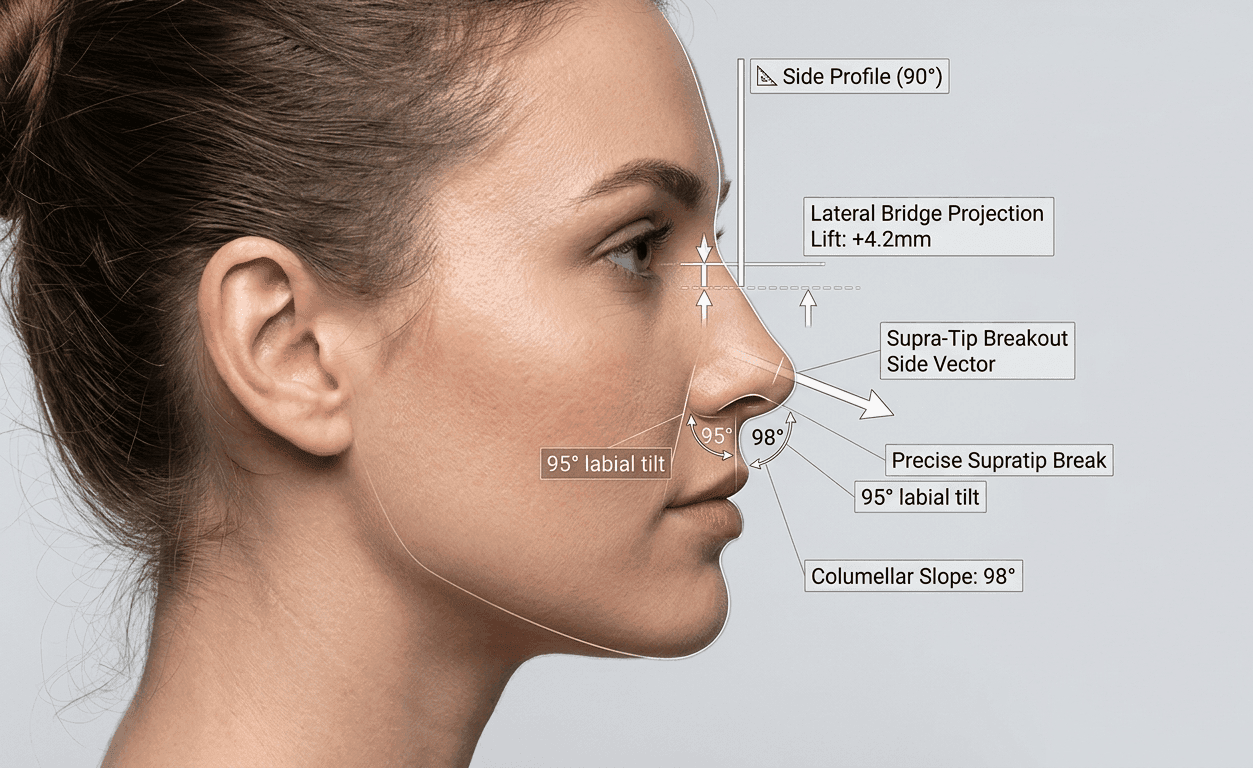
📐 Side Profile (90° )
Active Perspective Spec
Supra-Tip Breakout Side Vector
Maintains a precise supratip break, sloping down elegantly into a 95° labial tilt. This design supports the tip permanently, protecting skin thickness and avoiding a hard, bird-like point.
- Lateral Bridge Projection Lift: +4.2mm
- Columellar Slope: 98°
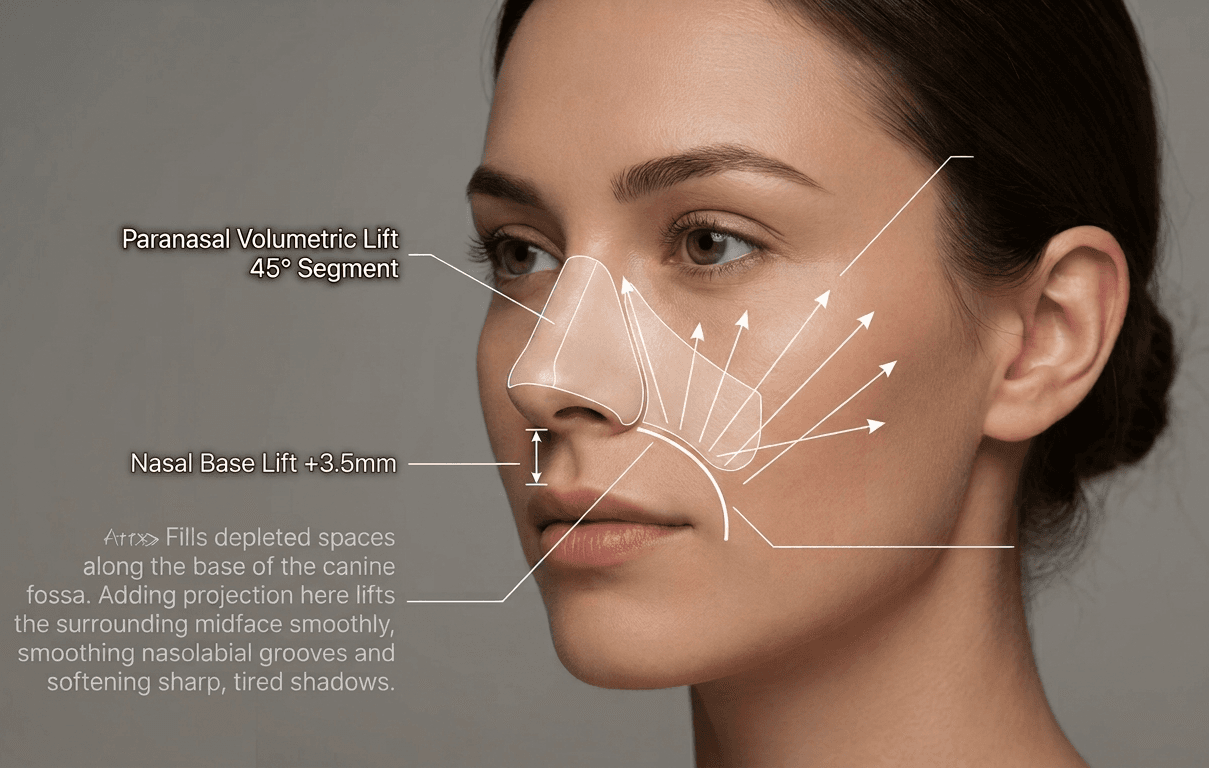
📐 45° Contour (45° )
Active Perspective Spec
Paranasal Volumetric Lift 45° Segment
Fills depleted spaces along the base of the canine fossa. Adding projection here lifts the surrounding midface smoothly, smoothing nasolabial grooves and softening sharp, tired shadows.
- Nasal Base Lift: +3.5mm
- Nasofacial Transition Line: Perfect Soft Shade
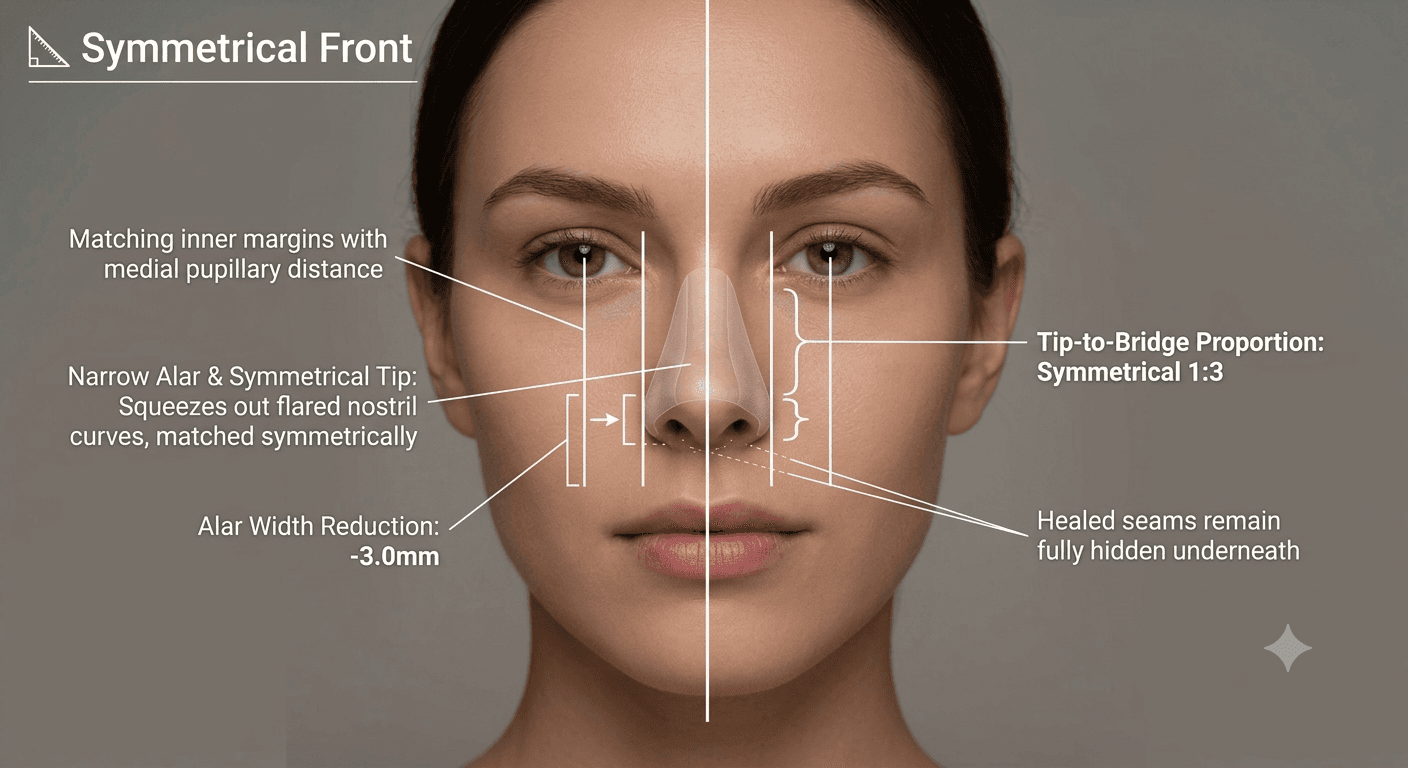
📐 Symmetrical Front
Narrow Alar & Symmetrical Tip
Squeezes out flared nostril curves from the side walls, matching the inner margins with your medial pupillary distance symmetrically. Healed seams remain fully hidden underneath.
- Alar Width Reduction: -3.0mm
- Tip-to-Bridge Proportion: Symmetrical 1:3
ESTABLISHED CLINICAL AIRWAY CONTROLS
Double-Failsafe Rhinoplasty Safety
ESTABLISHED CLINICAL AIRWAY CONTROLS
We focus on safety and structure first. We never harvest autologous cartilage without strict preoperative screenings to map reserves. All nose tunnels are modeled with custom surgical splints and we maintain airway volume boundaries above 95% of initial thresholds under digital simulations to prevent blockages or breathing reductions after surgery.
Want to learn about your Rhinoplasty options?
Book a one-on-one consultation for personalized advice.
Free Consultation